

Originally published on Metrospective Pro on 10 March 2026.
In the digital age, education and professional development have evolved far beyond traditional classroom settings. The concept of lifelong learning calls for modern systems that can recognise and verify skills and achievements. One such system that has gained considerable traction is digital badges (hereafter referred to as badges). These are secure, portable, and verifiable online credentials.
Badges fall under the wider umbrella of digital credentials. A digital credential is not just a scanned copy, but an original, digitally-issued version of traditional credentials like diplomas or licences. They are protected against fraud, can be securely stored and shared online, and automatically read and verified by computer systems. (Europass n.d.b.) Badges are one way to implement digital credentials.
Key approaches to digital badges
Globally, the most recognised approach to digital badges is based on the Open Badge standard that badge platforms can adopt. Open Badges offer a free and open digital standard for packaging and sharing information about a specific recognition or achievement, such as skill, competency, or completed task.
An Open Badge, originally developed by the Mozilla Foundation (2011), is represented by an illustrated digital token with detailed information about what it represents. A special JSON or JSON-LD file is attached to the badge, storing metadata about the credential, such as who earned it, who awarded it, and what skill or achievement it represents. This information can be safely shared online, posted on a website, or imported into a digital wallet. (1EdTech Consortium 2025; 1EdTech Consortium 2026.)
Another notable system is the European Digital Credentials for Learning (EDC), which offers a free-to-use infrastructure for any organisation interested in building and issuing EDCs. This infrastructure consists of web tools that enable organisations to create templates and issue credentials, such as badges and diplomas. Individuals can apply for, view, store, and share the credentials they receive.
EDCs can be created in a multilingual form and are compatible with standard-compliant digital wallets, such as Europass. The service also allows organisations to implement their own custom-built solutions based on the open-source code provided. EDCs can also take forms other than badges, including official diplomas or certificates. (Europass n.d.a.)
This transforms a badge from a simple icon into a portable, verifiable digital credential with metadata, including information about the issuer, recipient, criteria for earning the badge, issue date, and any supporting evidence or links. By including metadata, digital badges can be trusted and independently verified, which builds transparency, portability, and trust across education and professional fields. Ultimately, the value of a badge is backed by the authority of the issuer and the quality of the recognition process and assessment criteria they use. (Motheeram, Herselman & Botha 2018, Mozilla Foundation 2014.)
Digital badges can be used as micro-credentials
Badges are also linked to micro-credentials, which are certifications that recognise the achievement of specific skills or knowledge through short, targeted learning experiences. Micro-credentials are used to complement traditional qualifications and can be earned through various providers and learning settings. (European Union 2022.) Badges can be used to issue micro-credentials but they are not automatically the same thing.
The linkage is important as micro-credentials are widely recognised. For example, EU member states are encouraged to use them to strengthen and complement existing learning opportunities and increase participation in lifelong learning by enabling individuals to acquire, update, and improve their knowledge and skills for future labour market needs. (European Union 2022.) Micro-credentials are always tied to a facilitated learning opportunity, so they are not as flexible as badges that recognise and validate also independently acquired and developed competences (Heinonen 2025).
Comparison of participation-based and competence-based badges
Badges can be issued for a wide range of achievements such as formal education and training, non-formal learning, online courses, volunteering, and learning mobility experiences. Badges can generally be divided into two categories: participation-based and competence-based. This distinction is crucial for their effectiveness in professional contexts (Heinonen 2025).
Participation-based badges are awarded simply for being present at an event or completing an activity, such as attending a webinar or workshop. While these badges can encourage engagement, they do not verify any specific skills or learning outcomes.
Competence-based badges, by contrast, recognise proven skills or knowledge. To earn one, the learner must provide concrete evidence, such as a project or assessment, which is then evaluated against clear, predefined criteria. These badges offer credible validation of abilities and are also valued by employers. (Heinonen, 2025; Motheeram, Herselman & Botha 2018.)
In short, participation-based badges highlight involvement, while competence-based badges provide trusted, skill-focused recognition, making them especially useful for professional and educational pathways.
How competence-based badges work?
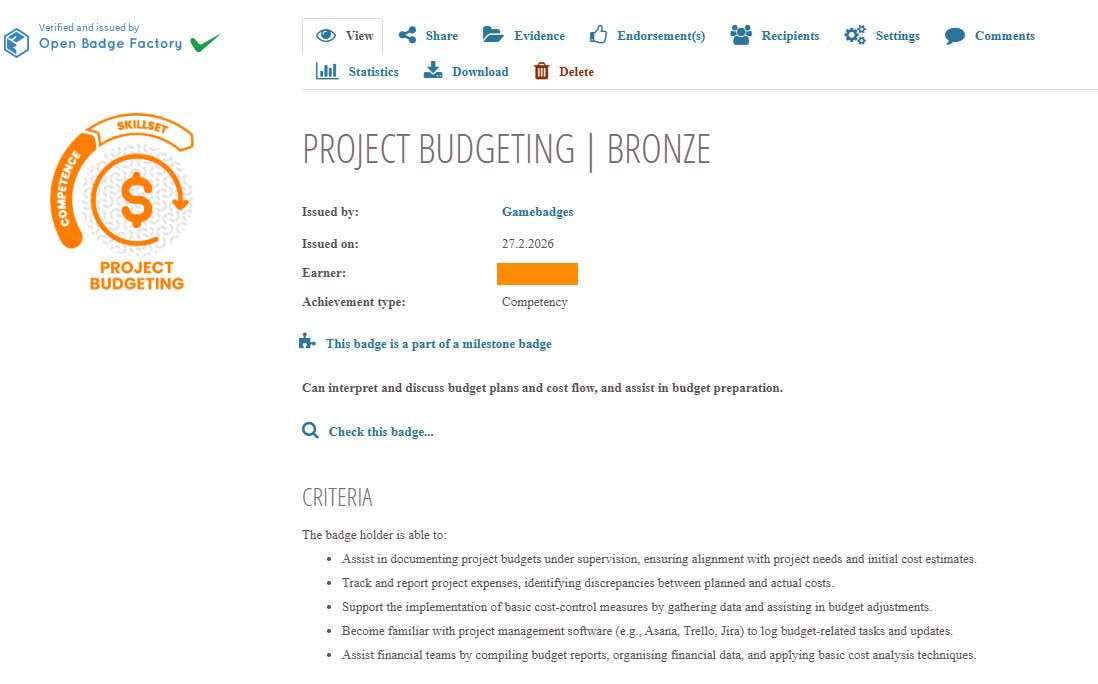
Competence-based badges contain several key pieces of information:
- Issuer: The organisation or institution that grants the badge.
- Recipient: The individual earning the badge.
- Criteria: The requirements needed to earn the badge.
- Evidence: This can include files, projects, or a portfolio showing proof of the individual’s accomplishment.
- Date: The date when the badge was issued.
All this data is embedded within the badge itself, making it easy for employers or institutions to verify the authenticity of the achievement without relying on the issuing organisation. Usually, the badge has a link to a site where verification can be done. If the digital badge has been printed or delivered as a PDF file, it includes an address where this verification can be done.
Ensuring credibility of competence-based badges
Despite their growing popularity, challenges associated with implementing digital badges remain. One is ensuring the quality of competence-based badges. While the Open Badge and EDC standards provide a technical foundation for issuing badges, they do not offer guidelines on describing what badges represent, or on setting trustworthy criteria for issuing and evaluating them. As a result, these key decisions are left to the organisations that issue these badges.
Since anyone can technically issue badges, ensuring their credibility is essential, particularly from an employer’s perspective. Employers are more likely to recognise and value badges when they trust not only the issuing organisation, but also the underlying concept and purpose of competence-based digital badges as a means of demonstrating abilities. (Heinonen 2025.)
Several EU-funded projects have explored ways to support this credibility. One of them is the Gamebadges project, coordinated by Metropolia University of Applied Sciences. During the project, a digital, a competence-based badge ecosystem for the game industry was created.
The project ensures credibility through the following measures:
- Each badge description and its requirements have been designed in collaboration with industry experts.
- Each badge outlines both the requirements for achieving the badge and the criteria by which applications are assessed.
- To apply for a badge, evidence must be presented based on the badge requirements.
- Using previous work or study samples is allowed with limitations. For example, instructions are provided on how to demonstrate individual contributions in teamwork samples, and guidance is given on handling material restricted by NDA or GDPR requirements.
- Applicants receive clear guidance on the use of AI and are expected to submit a declaration of AI usage.
- Each badge application and associated evidence is evaluated by an expert in the field.
- Each evaluator must complete evaluator training and agree to comply with the rules, evaluator manual guidelines, and the code of ethics.
The creation of Gamebadges and their ecosystem has not been a quick process. It builds upon the previous project, Chips for Game Skills, and has required thorough testing before its public release (the system is currently in closed testing), as well as ongoing updates to keep pace with the fast-evolving industry. One of the outcomes of the Gamebadges project will be a process analysis to guide others wishing to implement an ecosystem of this scale, not as a technical manual, but to provide guidance and insights into the process and the lessons learned.
References
1EdTech Consortium. 2025. Open Badges Specification 3.0. Accessed 19 February 2026. https://www.imsglobal.org/spec/ob/v3p0/main/
1EdTech Consortium. 2026. Open Badges. Accessed 19 February 2026. https://www.1edtech.org/standards/open-badges
Europass. n.d.a. How to issue European Digital Credentials for Learning. European Union. Accessed 26 February 2026. https://europass.europa.eu/fi/how-issue-european-digital-credentials-learning#
Europass. n.d.b. European Digital Credentials. European Union. Accessed 26 February 2026. https://europass.europa.eu/fi/european-digital-credentials
European Union. 2022. COUNCIL RECOMMENDATION of 16 June 2022 on a European approach to micro-credentials for lifelong learning and employability. EUR-lex. Accessed 19 February 2026. https://eur-lex.europa.eu/legal-content/EN/TXT/?uri=oj:JOC_2022_243_R_0002
Heinonen, S. 2025. From Classroom to Game Studio – The Role of Badges in Game Industry Competence Mapping. Published 14 May 2025. Metrospective Pro. https://urn.fi/urn:nbn:fi:muas-issn-2984-4134-92
Motheeram, P., Herselman, M. & Botha, A. 2018. A scoping review of digital open badge ecosystems in relation to resource-constrained environments. The Journal for Transdisciplinary Research in Southern Africa. https://doi.org/10.4102/td.v14i1.463
Mozilla Foundation. 2011. Mozilla launches open badges project. Mozilla Blog. Accessed 26 February 2026. https://blog.mozilla.org/blog/2011/09/15/openbadges/
Mozilla Foundation. 2014. Badges/FAQs. Last edited on 26 March 2014, at 16:39. Accessed 26 February 2026. https://wiki.mozilla.org/Badges/FAQs#Badges